The reel begins with a woman in expensive matching activewear, in a converted warehouse with exposed pipes and warm Edison bulbs. She moves into a difficult arm balance. A caption appears. Find your power. Two hundred thousand people have liked it. The next reel is a chai recipe.
This is what the word yoga means in 2026 in most of the world. A photogenic posture in a converted warehouse. A few breaths before. A green smoothie after.
Patanjali, who compiled the foundational text of yoga around two thousand years ago, dedicated three sentences to the postures. Three. Out of about one hundred and ninety-six.
We have built a billion-dollar global industry on the smallest part of his system, and largely thrown the rest away.
What yoga actually is
The classical text on yoga is the Yoga Sutras of Patanjali. It is not a religious book. It is a manual. It compresses the discipline into eight limbs, called ashtanga, which means simply “eight limbs.”
The eight, in the order Patanjali gives them.
Yamas. Ethical restraints. Five of them. Non-violence, truthfulness, non-stealing, self-restraint, non-grasping.
Niyamas. Personal observances. Cleanliness, contentment, discipline, self-study, surrender.
Asana. Posture. Steady and comfortable. That is the entire definition Patanjali gives.
Pranayama. Regulation of the breath.
Pratyahara. Withdrawal of attention from the senses.
Dharana. Concentration. The mind held on a single object.
Dhyana. Meditation. Concentration unbroken over time.
Samadhi. Absorption. The dissolving of the boundary between the watcher and the watched.
The first two limbs are how you live. The third is how you sit. The next four are about what your mind does. The eighth is what is left when the practice has actually worked.
Modern yoga, in India and abroad, has kept the third limb and dropped most of the rest.
Why this matters
You can argue that simplifying made yoga accessible to billions of people who would otherwise never have touched it, and there is something to that. But what got accessible was not yoga. It was a stretching class with the word yoga on the door.
The part of yoga that would actually help a modern Indian is the part that did not get sold to anyone. The withdrawal of attention. The training of the mind to stay on one thing. The slow undoing of the habit of being yanked around by every notification, every WhatsApp forward, every algorithmic feed. This is not a spiritual flourish. It is the entire practical proposition.
A person who has trained their attention for twenty minutes a day for two years has a different kind of life than a person who has not. They are harder to manipulate. They sleep better. They are less reactive in arguments. They notice when they are about to be sold something. They are, in the precise classical sense, more free.
The research the wellness industry does not advertise
For the last two decades, the cognitive science of meditation has quietly produced a body of evidence the western journals take seriously.
Sara Lazar’s MRI work at Harvard found measurable thickening of cortical regions associated with attention and interoception in long-term meditators, and detectable changes in the same regions after eight weeks of regular practice in beginners. Richard Davidson’s lab at the University of Wisconsin has spent over twenty years documenting changes in amygdala reactivity, default-mode-network activity, and emotional regulation in trained meditators. The mindfulness-based stress reduction programme that came out of this research, originally developed by Jon Kabat-Zinn at the University of Massachusetts in 1979, is now used in hospitals across Europe and the United States.
The findings are modest in size and large in implication. Modest, because nobody in the lab is claiming meditation will give you superpowers. Large, because the brain, the organ that everyone in the wellness industry has agreed must remain unchangeable in adulthood, in fact changes when you train it.
The research is interesting in its own right. It is more interesting because it confirms, in the language of MRI scans, what Patanjali wrote down before the Roman Empire reached its peak.
What you can do this week
You do not need a guru. You do not need a retreat. You do not need to buy anything.
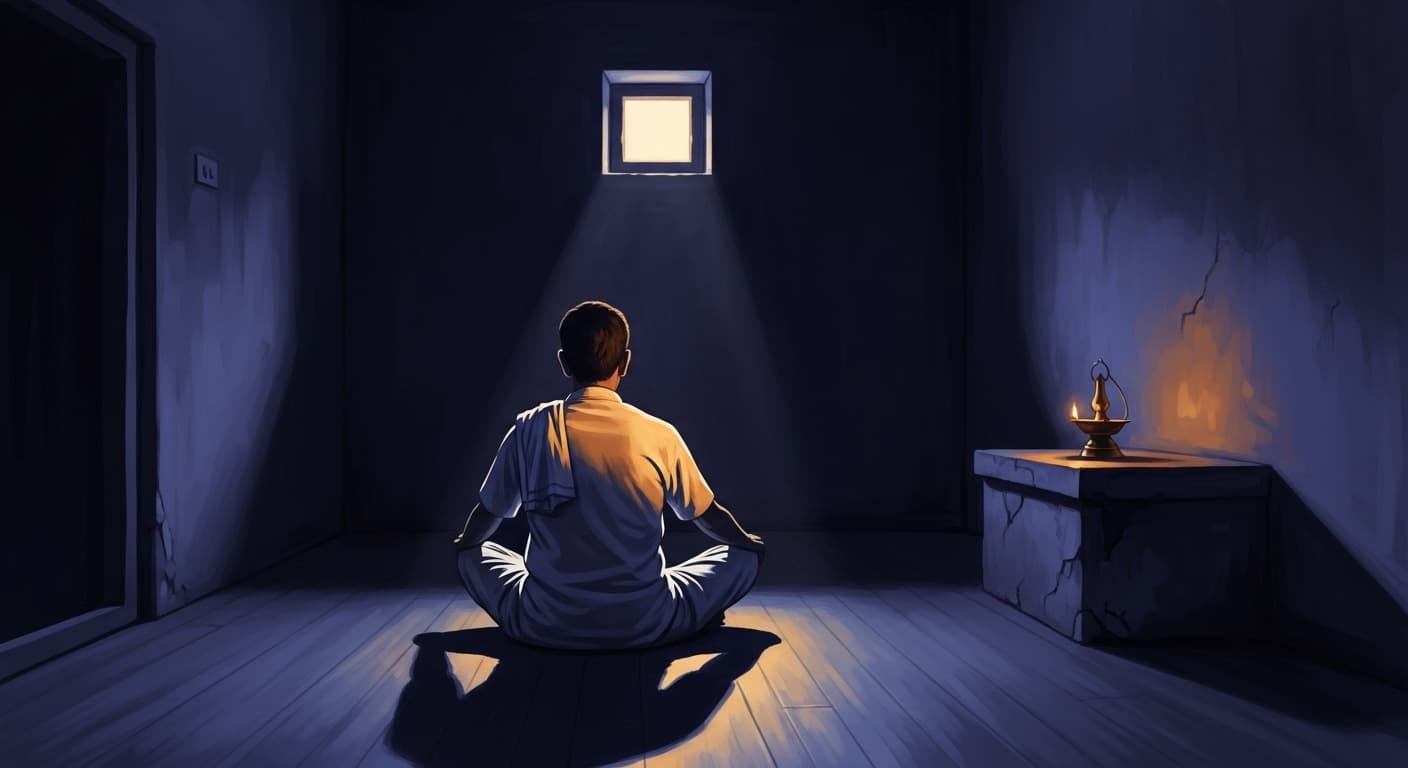
Sit on the floor or on a chair with the spine upright. Close your eyes. For ten minutes, every time you notice that your mind has wandered off, return your attention to the breath. Do not judge the wandering. Do not narrate the success. Just bring the attention back. That is the whole technique.
Do this once a day for sixty days.
If at the end of sixty days you find no change, you may stop. We will not be insulted. The practice is older than us, and it does not need our advertising.
If you find a change, you have begun the third limb. There are seven others.